

- By Admin
- 27 Feb
In-House vs BPO Live Chat: Cost & Performance Comparison
One of the most consequential decisions a growing business faces is whether to build an in-house live chat team or partner with a Business Process Outsourcing provider for customer support. Both models come with distinct advantages, trade-offs, and long-term implications for cost, performance, and scalability. This in-house vs BPO live chat comparison breaks down exactly what each approach delivers — so businesses can make a confident, data-informed decision that aligns with their goals and their budget.
Setting the Stage: What Each Model Involves
Before diving into the cost and performance comparison of BPO live chat against in-house operations, it helps to understand what each model actually entails. An in-house support team consists of employees hired, trained, and managed directly by the business. They work within the company's infrastructure, use its tools, and are under direct management oversight at every level.
A BPO live chat model, by contrast, involves outsourcing the customer service function to a specialized third-party provider. That provider supplies trained live chat agents, live chat software, CRM integration, helpdesk services, and the full operational stack — managing everything from workforce management and recruitment process to performance metrics and Service Level Agreement compliance. The client benefits from the output without bearing the burden of the underlying operations.
BPO Live Chat Cost Comparison: What Businesses Actually Spend
The True Cost of an In-House Live Chat Team
Building an in-house live chat operation carries costs that extend well beyond basic salaries. When all expenses are factored in, the financial picture becomes significantly more demanding than most businesses initially anticipate. The key cost components include:
• Recruitment Process — job postings, screening, interviewing, and onboarding each new agent require both time and financial investment.
• Employee Training — new agents require structured training programs covering product knowledge, customer service standards, and live chat software proficiency before they are ready to perform.
• Infrastructure Costs — office space, hardware, internet connectivity, licensing fees for platforms like Zendesk, Intercom, or Freshdesk, and ongoing IT support all contribute to fixed overhead.
• Operational Costs — management salaries, HR administration, payroll processing, employee benefits, and attrition-related replacement costs compound over time.
• Scalability Limitations — expanding an in-house team during peak periods requires lead time for hiring and training, making rapid scaling both slow and expensive.
BPO Live Chat Pricing: A More Predictable Cost Model
BPO live chat pricing operates on a fundamentally different structure. Rather than managing dozens of individual cost variables, businesses pay a clear, predictable fee for a defined scope of service. BPO services providers typically offer per-agent, per-hour, or monthly retainer pricing models — all of which are significantly lower than the fully-loaded cost of equivalent in-house staffing.
Offshore and nearshore outsourcing models deliver even greater cost reduction without compromising service quality. A business that might spend considerably on a single in-house agent — accounting for all associated overheads — can often access a fully trained, professionally managed BPO live chat agent for a fraction of that investment. This cost efficiency is one of the primary reasons outsourced vs in-house customer support comparisons consistently favor the BPO model for growing organizations.
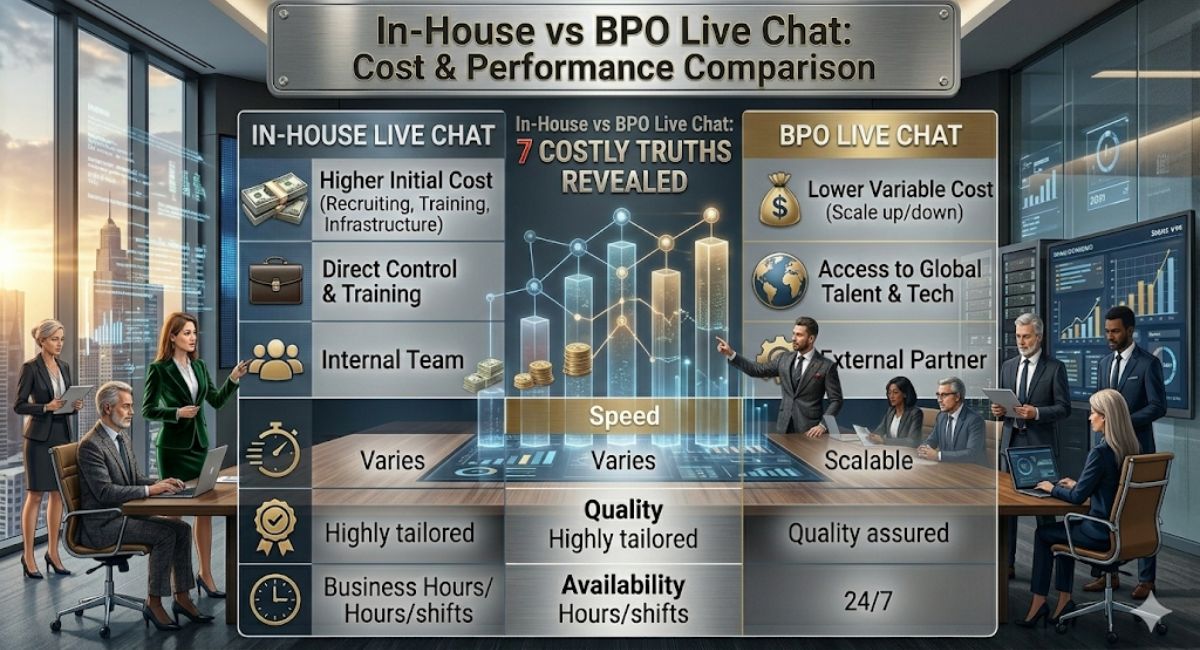
Quick Cost Comparison Snapshot:
Cost Factor | In-House Team | BPO Live Chat |
Recruitment & Hiring | High | Included in Package |
Employee Training | Ongoing Internal Cost | Managed by Provider |
Infrastructure Costs | High Fixed Overhead | Minimal |
24/7 Coverage | Very Expensive | Standard Offering |
Scalability | Slow & Costly | Fast & Flexible |
Overall Cost Efficiency | Lower ROI | Higher ROI |
Live Chat Performance Comparison: Measuring What Matters
Cost is only half of the equation. For businesses evaluating which is better — in-house or BPO live chat — the performance comparison is equally important. The metrics that matter most in customer support operations are First Response Time, Average Handling Time, Customer Satisfaction Score, and conversion rate optimization outcomes. Here is how both models stack up.
In-House Team Performance: Strengths and Limitations
In-house support teams offer genuine advantages in terms of brand familiarity and direct management oversight. Agents who work within the business develop deep product knowledge over time and often carry strong brand affinity — qualities that can translate into highly personalized customer interactions. Productivity within a well-managed in-house team can be strong when demand is stable and predictable.
However, in-house teams face significant performance challenges when conditions change. Demand surges, agent attrition, management gaps, or inadequate live chat software can quickly erode First Response Time and Average Handling Time metrics. Without a dedicated operations team focused exclusively on workforce management and performance tracking, maintaining consistent Service Level Agreement compliance becomes increasingly difficult as the business grows.
BPO Live Chat Performance: Built for Consistency at Scale
BPO live chat providers are built specifically around performance. Their entire operational model is designed to deliver measurable results — consistently, at scale, and across every shift. Dedicated remote support teams are trained not only in customer service fundamentals but also in the nuances of the client's brand, products, and customer expectations. AI chatbots handle the initial wave of routine inquiries, keeping Average Handling Time low while ensuring that human agents focus their energy on interactions that genuinely require empathy and judgment.
CRM integration with tools like Zendesk, Intercom, and Freshdesk gives BPO agents instant access to customer history, previous interactions, and purchase records — enabling personalized, efficient support from the very first message. Omnichannel support capabilities ensure that customers receive the same quality of service regardless of the channel they use. Performance metrics are tracked in real time through analytics dashboards, and transparent reporting against Service Level Agreement benchmarks keeps both parties accountable.
Scalability and Management: Where BPO Has the Clear Edge
When comparing live chat outsourcing vs in-house team models on scalability and management complexity, the BPO advantage becomes particularly clear. In-house operations require businesses to manage every dimension of the support function — hiring cycles, shift scheduling, performance management, technology upgrades, and agent wellbeing. This management overhead consumes significant internal resources that could otherwise be directed toward growth.
BPO live chat providers absorb that management burden entirely. From workforce management and ticketing system administration to agent training, quality assurance, and real-time performance reporting, the BPO partner handles the operational complexity — leaving the client free to focus on strategic priorities. The scalability of the BPO model means that whether a business needs five agents or fifty, capacity adjustments happen quickly and without disruption.
Which Is Better — In-House or BPO Live Chat?
For businesses weighing the decision honestly, the cost and performance comparison of BPO live chat vs internal customer service teams points clearly in one direction for most growth-oriented organizations. BPO live chat delivers lower operational costs, faster scalability, more consistent performance metrics, and access to enterprise-grade technology — all without the management complexity of running an internal team.
In-house teams remain a valid choice for organizations where deep internal brand integration is non-negotiable or where support volume is low and highly stable. But for the majority of businesses navigating growth, seasonal demand fluctuations, or the need for 24/7 customer support coverage, outsourced live chat support delivers a stronger return on investment — consistently, measurably, and at a cost that supports rather than strains the business.
Final Verdict: Cost, Performance, and the Smarter Long-Term Choice
The in-house vs outsourced live chat support debate ultimately comes down to priorities. If the priority is control at any cost, an in-house model offers that — but at a price. If the priority is efficiency, scalability, consistent performance, and measurable ROI, BPO live chat pricing vs internal team cost comparisons make the outsourced model the overwhelming choice.
For businesses ready to move beyond the limitations of in-house customer service and unlock the full potential of professional BPO services, the path forward is clear. Outsourced live chat support is not simply a cost-cutting measure — it is a strategic upgrade that delivers better performance, stronger customer satisfaction, and a foundation for sustainable, scalable growth.